
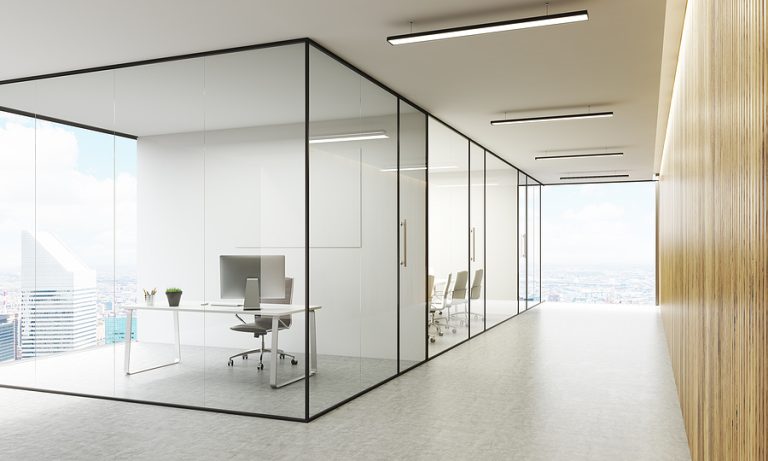
The modern office has a design dilemma that can only possibly be solved through the use of advanced and innovative materials. Businesses want light and clarity without losing privacy.
The principle of daylighting is a fundamental philosophy behind modern office design, with gleaming glass offices, partitions and sliding doors.
At the same time, privacy is not a negotiable element, with both professional and financial implications if the pursuit of a bright open office space does not allow for personal comfort and both visual and aural privacy.
Thankfully, thanks to soundproof glass and frosted glazing, you do not need to choose. But how is glass soundproofed, and why does this matter?
What Is Soundproofing?
The concept of soundproofing, or reducing the intrusion of sound from one area to another, generally requires materials to have one or more of the following properties:
- Block sound waves.
- Absorb or dampen sound waves.
- Reflect sound waves away from a room.
The goal is to create a barrier between one room and another to allow for a quiet space, but this typically requires thick, absorbent, and typically opaque materials that stop sound from passing through them.
In rooms which require more heavy-duty soundproofing, such as recording studios, this is typically done using heavy building materials, acoustic foam and blackout curtains, but these options are incompatible with the daylighting approach of typical offices.
How Is Glass Soundproofed?
To get around this, soundproofing glass often uses multiple methods to help redirect, absorb and block sound.
One approach is to use a vacuum cavity similar to those used in double-glazed windows. The same vacuum layer which improves thermal efficiency also stops sound from bleeding out and bleeding through. Sound does not travel in a vacuum.
Whilst the specific sound dampening will vary based on a huge number of factors, standard double glazing will provide a sound reduction benefit of about 35dB, whilst specialist soundproof glass can provide even greater benefits of potentially over 50dB depending on the specific installation.
This is typically combined with a laminated layer, which provides a further physical sound barrier by dampening sound waves and enabling the use of more glass layers that further mute sound.
An interesting physical quirk is that the best soundproof glass produced in this way will use glass panes of varying thickness, as they provide better soundproofing performance.
Typically, these elements are combined and balanced against each other to find the right combination of aesthetics, thickness, practicality, soundproofing and affordability.
Why Is Soundproof Glass So Important?
Privacy is vital for businesses; every organisation needs a meeting room or separate office cubicles which provide privacy and quiet from the main space.
There always needs to be a place to make confidential phone calls, have quiet meetings or carefully reflect on business documentation, and many open plan offices with conventional glass partitioning may not provide that opportunity.
If there is a knowledge or even a suspicion that important details could travel out of a meeting room, it can create a chilling effect that can stop vital information from being discussed.